
The July Barbers

I’ve been fairly quiet recently – that’s for a couple of reasons. Firstly I’ve been preoccupied with the final texts of a new book of short stories and, secondly, because I’ve been away in Scotland for the Dick Gaughan concert at the Royal Concert Hall Glasgow where a full house cheered to the stars and gave the man a standing ovation as he walked on stage to join us in the last two songs of the night. The final song Freedom Come All Ye, written by that other great Scot Hamish Henderson, was the perfect way to end a tribute to a living legend. I’ll write more about Dick in a full posting soon - Working Class Hero No3. Meanwhile – about the new book.
The book is called The Jockey and is Vol 3 in the series of books of short stories: Vol 1 is Specky Four Eyes, Vol2 is As The Sky With Stars. The Jockey will be published at the end of March.
The eight tales in The Jockey are all either set in Ireland or in the Irish communities in the UK. One of the stories set in the UK is called The Last Of The July Barbers, and it tells the story of Séamie Lennon, a man from Mayo, in his late thirties who comes every year from his home in Bohola to earn much needed money working the hayfields in a farm in the Yorkshire Dales in the North of England.
The Irish lads were known locally as The July Barbers because ‘they came each year to shave the fields.’ They slept in barns or byres and worked the haytime in the Dales before going back home at the end of summer in time (hopefully) to save their own hay. The mother of one of my Yorkshire Dales friends, a farmer’s wife now in her nineties remembers the same men men coming each year to her farm and remembers them with fondness, in her case the same man came for several years. The story, as the title suggests, is about the last of the Irish lads to come to the Dale and the narrator is a man who was a child at the time so the tale within a tale is about change and culture and love and time now gone.
My first book of poems (published after I’d sent my work in under an assumed name: Christophe O’Neil, contains the poem below. To explain a little….
The poem kicks off in the 6/8 time of the trad Irish jig; then it falls into a jumble of words as the lads tumble into the farm and, with the morning comes the long hard graft of the mowing and raking.
“Six miles to mass” - because the nearest Catholic church in one case was six miles away.
Methody ranting - Methodists hymn singing.
Penyghent is one of the three peaks of Yorkshire and one of the few remaining Celtic topographical names in that area.
Crough Patrick is a holy mountain on the coast of Mayo and a place of pilgrimage - the main day being the last Sunday in July when some will climb ’The Reek’ (the mountain) barefoot.
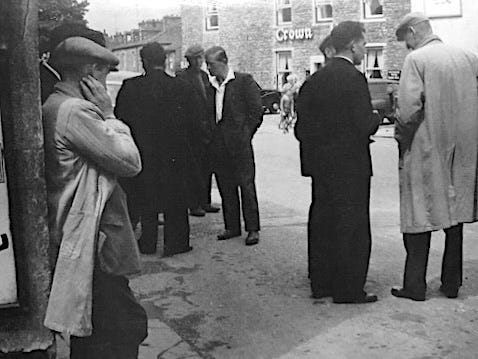
The picture above shows Irish lads (in their best suits) standing to be hired at Hawes Hiring Fair 1964. It’s from a book called ‘The Irish In Britain’ - pub. The Guardian.
The July Barbers

From Mayo, God help us, each summer they came,
And stood to be hired in Salt Kettle Lane,
And the farmers would pass with a swagger and a nod,
A hand slap, a wink, the chink of a few bob,
To drink 'your man's health' and the bargain was struck,
Binding them to the land.
The truck picked them up when the pubs had all shut
And tipped them, drunk and staggering,
Into the lamplit yard, their beery breath
Wreathing round the moth-danced flame.

Then it was weeks of scything, raking, turning, loading,
Sun Up to the edge of light,
When blood spilled, ran, and filled the sky,
And men grew field-long stalking shadows.
Sleeping an hour they rose, swilling the night
Out of their eyes at the trough, washing
The gall of loneliness from their mouths,
The smell of bacon fingering the air
As mist smudged a heron on the river and a curlew
Bubbled at the orange ball that rimmed the fell.
Sunday, six miles to mass, on foot,
And six more back, then a few pints and the crack,
Three hours of bed and another rising, 'God bless the work!'

Some nights they sang in Irish beneath a shaking moon,
Moving through the watery light
Over a land fecund with seed and fruit.
They combed the hayfield mowing to the lilt
Of an old ballad, and called God's blessing on
The field’s pan-scrub chin, well razored.
‘Tis a shave will last all year mister!'

Later, from the barn the farmer heard
The soft murmur of Gaelic chanting,
'Like bloody Ju-Ju it sounded, Methody ranting.'
Peering through a crack he saw them kneel
Circled in the lamplight, as horny fingers,
Scythe-segged, told the Rosary through
And Penychent  became Crough Patrick.
The Jockey will be published in book form at the end of March - and will cost £10 plus P&P. Nat available in bookshops yet but available online www.mikeharding.co.uk We will take orders once the book has gone to press.
Save my a copy!
I was reading As The Sky With Stars on the plane from Knock last Friday. The fella sitting next to me said “Is that Mike Harding off the telly? I remember him.”